À la recherche du temps perdu — Why Combinaison Uses Nagajuban Silk

Nagajuban counts as underwear.
Under a Western suit, or under a dress. You would never walk around the house in a nagajuban alone.
And there is no fixed rule for what fabric a nagajuban should be made of.
Looking at my mother's nagajuban, they are made from chirimen, rinzu, mousseline, hemp — all kinds of materials, and some are remade from haori that had grown too showy to wear as is.
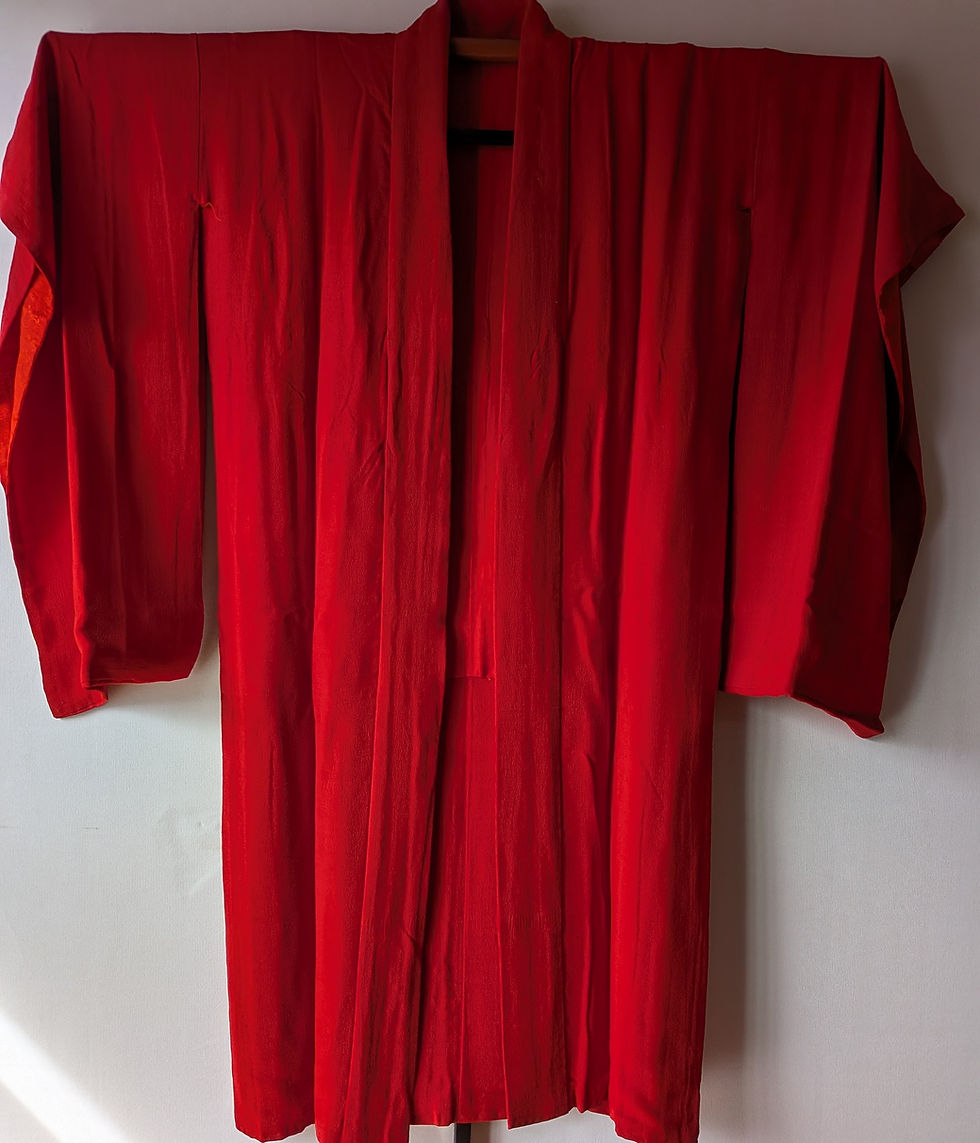
There is a view that says: it's underwear, so wear whatever you like. And there is another, just as deeply rooted in Japanese aesthetics, that says: it is precisely what no one sees that deserves the most care.
A flash of scarlet chirimen nagajuban beneath a plain navy or brown kimono might quicken someone's pulse.
Rinzu is the most common fabric used for nagajuban. The reason comes down to one thing: how it feels against the skin.
The moment it touches bare skin — that slick, liquid-smooth texture unique to silk. It comes from the satin weave. It slides beautifully, which makes it ideal for layering under a kimono. A plain weave simply can't do this.
Rinzu's shine comes from that same satin structure.
There are fewer intersection points between the threads, and each thread floats longer across the surface. In a plain weave, warp and weft cross over and under one another with every single thread, so light scatters across all those crossing points and the surface reads as matte. In a satin weave, though, the warp thread floats over several weft threads in a row before finally dipping under one — and because the thread lies flat and long across the surface, light reflects back as one gathered, unified sheen.
Silk fiber itself helps too — its cross-section is close to a triangle, a shape that already refracts and reflects light beautifully. Layer that quality onto the satin weave's structure, and you get that particular glow rinzu is known for.

It slides well, and it wears light. That's why I think rinzu holds up just as well in modern Western clothing as it does in traditional dress.
You may never wear a kimono. But you can wear the art of Wasai.
On ne porte pas forcément un kimono. Mais on peut porter l'art du Wasai.
— PASSIONEER


Comments