À la recherche du temps perdu/A Kimono That Crossed Generations


My mother's coming-of-age ceremony photograph.
In those days, the kimono world was swept up in Rococo and Baroque influences. The spirit of postwar Japan — catch up, surpass — poured itself into design. An overwhelming longing for the West made its way into silk.
My mother's furisode was white, painted with Entasis columns and a palace in vivid color. Hand-applied gold leaf caught the light, making the palace shimmer and glow.
She wore that kimono to her first meeting with my father. She wore it again at their wedding, as her second outfit of the evening. Like a banquet in spring, the white palace must have shone more brilliantly than ever on that day.
It was her companion through the beginning of everything.
A kimono, unlike Western dress, becomes restricted with age — certain colors, certain patterns, no longer appropriate as the years pass. One cannot wear a coming-of-age furisode at sixty. And yet, to discard it feels unthinkable. It has walked alongside a life. It is a witness to time.

A kimono is made to be remade. This is its nature, and its quiet promise.
Following this principle, I decided to transform my mother's furisode into a kimono for my daughter's coming-of-age ceremony.
The white silk had gathered faint traces of time — spots, the quiet marks of decades. Beautiful in their way, but not the right beginning for a daughter stepping into the world.
I asked my daughter what she dreamed of.
Deep. Deep indigo-violet.
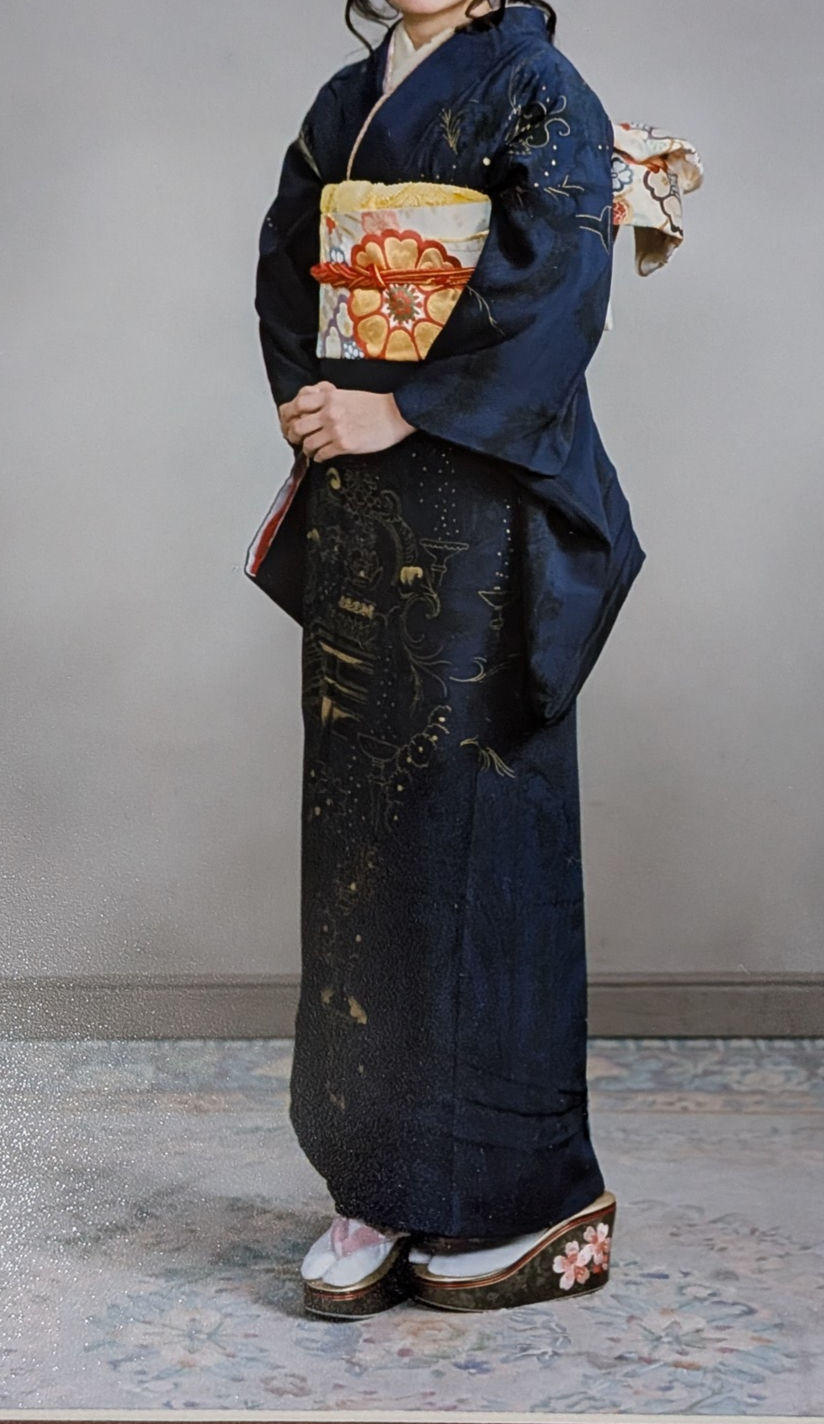
The kimono was dyed. The painted palace disappeared beneath the new color. Only the gold leaf remained — glittering, enigmatic, casting strange light from within the darkness.
Because the original design lay beneath the dye, something unexpected emerged. The new color fell unevenly, shaped by what was hidden underneath, creating shadows and depths that no dyer could have planned. You find yourself drawing closer, leaning in, studying the surface. The chirimen pulls you downward — into the deep sea, toward an ancient temple resting in silence on the ocean floor.
Sixty years had passed. And yet the chirimen had returned — reborn, transformed, alive.
A different body had worn it. A different life had called it forward.
The grand, brilliant palace banquet had dissolved. In its place: something mysterious, something ancient, something still.
To hold this reborn chirimen is to begin a descent.
Into the deep.
A romantic adventure.
A kimono is never finished. It breathes. It changes. It endures.
You may never wear a kimono. But you can wear the art of Wasai. — PASSIONEER

Comments