PASSIONEER
Are you giving up on trying to solve your kimono-related problems?
Let's transform your grandmother's kimono into a haori jacket again.
Let's turn that flashy haori jacket into an obi sash.
We'll help you wear your memories.
Let's breathe new life into your kimono through alteration and restyling.

Before
An antique formal kimono with a single family crest.
An elegant piece that evokes a sense of history.

After
Let's transform your grandmother's kimono into a haori jacket again.
Let's turn that flashy haori jacket into an obi sash.
We'll help you wear your memories.
Let's breathe new life into your kimono through alteration and restyling.
The family crests were removed, and the garment was restyled into a clean, modern-looking formal kimono.
Before
A kimono that's too short for a grandmother
A flashy haori jacket
A nagajuban (undergarment) with double-layered sleeves
Mourning clothes
A nagajuban with stains
A heavy obi sash
An old-fashioned design
As Western clothing
After
Remade into a haori jacket
Remade into a half-width obi sash
Transformed into a mock-kimono undergarment
Converted into a crested haori jacket
Dyed and updated to a modern style
Made into a pre-tied obi sash
Arranged in a modern style
Remade for everyday use
Frequently asked questions
We address these kinds of problems.
We will solve them all!


An antique obi before being remade. It has fading and wrinkles. The obi core is made of thick felt!
The garment was washed and pressed, leaving it clean and refreshed.
Restoration of an antique obi (sash) purchased online.
Although it was quite faded, the color scheme is a unique charm of antique pieces.
The customer's request was to somehow restore it and enjoy it again.


A tie-dyed formal kimono that has stood the test of time. It has been cleaned and refreshed through washing and pressing.
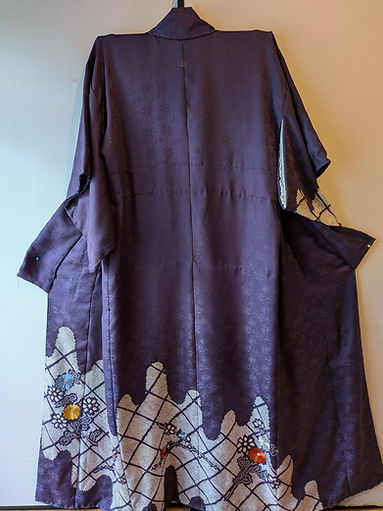
The customer had her mother's formal kimono tailored to her own size.
It's a beautiful kimono with intricate tie-dyeing.
The lining was also the original matching lining, so it was cleaned and pressed and used as is.
The result is a wonderful kimono perfectly fitted to her size.
The tie-dye pattern's colors were revived through the restyling process, giving it a lighter, more refreshing look.


I took the plunge and washed the tsumugi silk kimono myself.
I desperately ironed it to try and get it flat.
It's not quite turning out the way I wanted, though.
Since I want to wear it often as everyday wear,
I had it made with a partial lining (without lining in the body).
I bought it online for 500 yen. Due to years of storage, there are faint stains on the collar and cuffs. The lining is also completely yellowed.
The garment was carefully remade, and the texture of the silk fabric was restored.

Shichi-Go-San kimono from 50 years ago

Dyed purple

A Shichi-Go-San kimono I found at my parents' house.
No one wears it anymore. The pattern is too flashy as it is.
I learned that it could be dyed in a variety of colors, so I asked them to re-tailor it.
The Yuzen dyeing that my grandmother chose has turned it into a beautiful visiting kimono that is still fully wearable even 50 years later.


